
30 years of protest and love
Portrait of Stig Møller – published in the trade magazine Artisten September 2012 in connection with Stig Møller's 30th anniversary at Skanderborg Festival.,
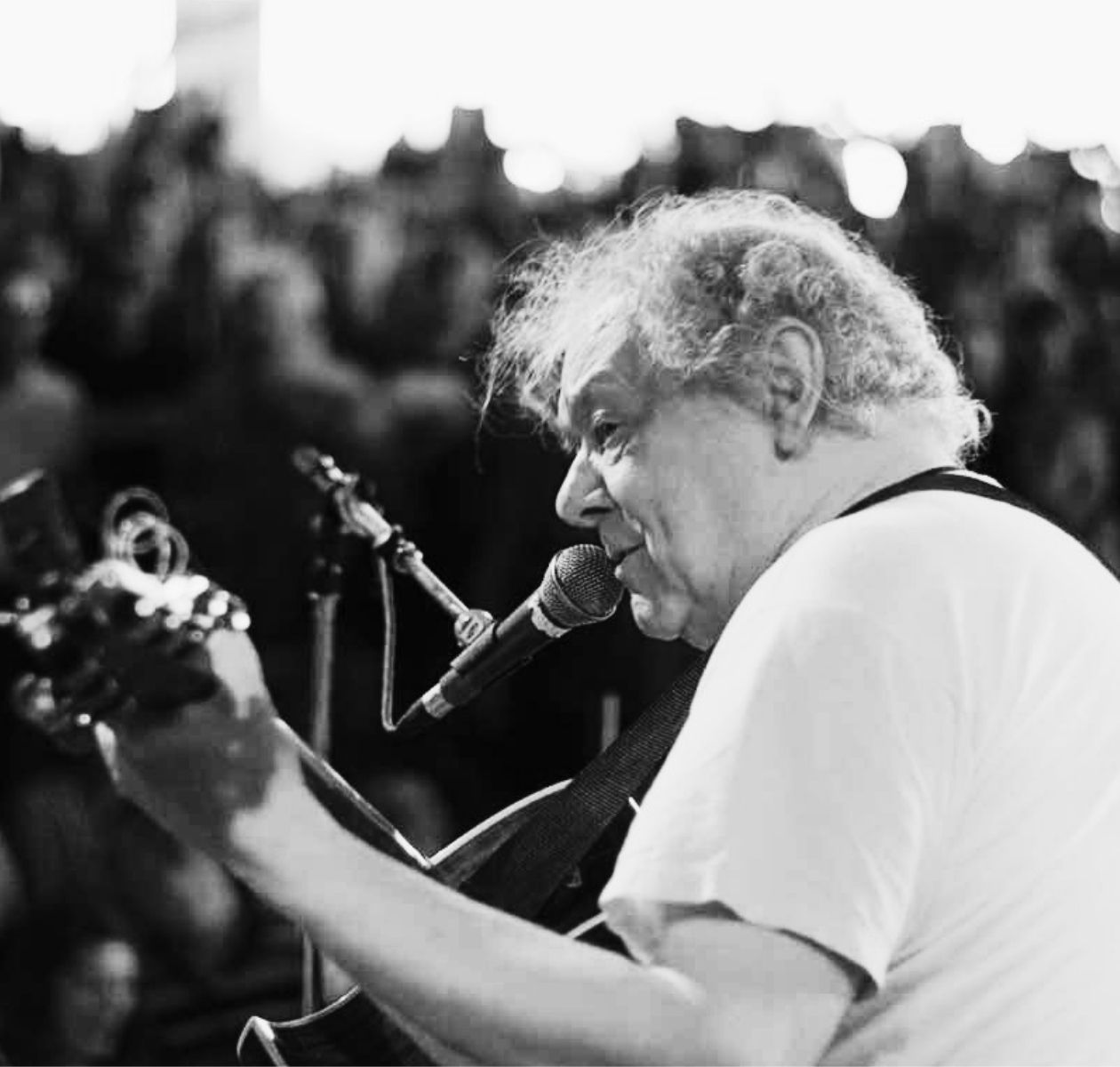
The tent is overflowing with hundreds of smiles and twice as many hands in the air. The first five rows of people have sat down and are swaying their upper bodies from side to side. Several have their eyes closed as they sing: “You make me warm, yes you make me warm”. From the stage, a grey-haired man in grey jogging bottoms leans back in his chair and beams a huge smile back at the audience. Stig Møller is celebrating his 30th anniversary at Skanderborg Festival, and it’s very difficult not to love the old hippie when he gets the entire tent to believe in his simple messages about loving each other and being happy with life.
In 1982, Stig Møller played for the first time at the then two-year-old festival, which had only a few thousand guests in total. This year, Skanderborg had 25,000 paying guests, and Stig Møller played on the free stage, Blusen, and performed his own anniversary concert on Sunday afternoon on Bøgescenen, where guest musicians paid tribute to Denmark's national hippie.
Until this year, Stig had his own little “Møllers stage” next to the main entrance of the festival grounds, where he played morning concerts for the hungover festival-goers. This year, Møllers stage has been decommissioned as part of a major redevelopment of the festival grounds, and this is not something that has gone down well with the jubilarian. Although he has been promised that he can play on the established stages at the festival for many years to come, he would rather play on very small stages where he has eye contact and can talk to the audience.
The man behind it all
In a sofa behind the scenes, Stig is enjoying the sun and the many fans of all ages, who approach him with lit joints or pat him on the back with a “Alright Møller”. Many of the younger ones want to have a chat about his time with the Steppeulvene, psychedelic trips, or his travels to the East. The sound engineer is tripping by and wants to get things sorted regarding how to set up for the concert.
“Well, I'm sitting on a chair on the right, Hans Fagt is in the middle, and Jens and Peter are on the left,” he says and returns to the conversation on the sofa.
Stig Møller smiles at the listening sofa guests and suddenly proclaims that he started the whole Skanderborg Festival in his day. In 1980, his concerts at the pub Marius Øltapper in Skanderborg attracted so many people that they had to sit out in the street.
“And then it was, we talked about doing something down in the woods,” he recalls and jumps on to stories about how he also started Roskilde Festival, made Denmark's first porn film and got Niels Skousen writing songs again for the comeback album “Dobbeltsyn”.
The protest comes between the songs
“What a lovely day it is today” can be heard in Stig Mølle's biggest hit, which since 2009 has made the old hippie a household name and is frequently played alongside dansktop hits on the radio.
And although the lyrics are more reminiscent of Kandis than Syrerock, the old protest against the bourgeoisie, politicians and banks lies constantly beneath the surface, peeking out in the form of comments between songs or to random audience members backstage on this undeniably lovely day at the Skanderborg Festival.
“It's bloody hard to help those arseholes, but I try to see them as little children in nursery. Then you can perhaps better understand why they are such idiots. Because they've apparently been mistreated somewhere,” he says.
He continues the incantation between songs on stage, but the audience doesn't seem to take it in and instead smiles indulgently, while they wait for their next fix of joy. It's the smiles and the love they come for. The togetherness. Two souls, one thought, can make a heart beat.
Stig Møller has on a single occasion tried his hand at the socially critical song “Arbeit macht frei”. However, it will not find its way onto the setlist for the concert at Skanderborg Festival, because according to Stig, bassist Peter Ingemann doesn't think it fits in.
“Apparently, I'm too direct and too crude to write protest songs, so Peter is afraid of it,” he says.
Was beaten and rejected
Stig himself was beaten as a child and has struggled his whole life with rejection. By his mother, father, and girlfriends. Since then, he has managed to turn his anger into something positive by meditating.
“It's a bit far out, what you can achieve by loving everything. Try looking at that cloud over there. If you jump into the cloud and practically love it to death, you'll get all its energy back. Do you understand?” he asks.
I don't quite get it, but I'm starting to understand his indomitable optimistic belief that things will work out if you just believe in it enough and send positive thoughts in the right direction.
Peter Ingemann says that he had become a bit worried about Stig at one point, as he was having some problems with unemployment benefit activation. But Stig explained that he had already created a meditation programme that would solve the problems.
Peter was still a little worried, however, and therefore began to make calls to book some gigs. Afterwards, he called Stig and asked him to note down when they were supposed to go out and play, to which Stig let out a loud laugh: “There you see, what I said. It worked then.”.
The young people have embraced Stig Møller.
“Samba, samba, samba,” sings Stig from the stage. “Kiss, kiss, kiss,” the whole tent bellows in chorus. A young man has written “Stig Møller is God” on his t-shirt, bringing back memories of Poul Kjøller's comeback in the 1990s.
Down among the front rows for the concert, a woman in her 50s is pouring tea into a cup from a thermos flask she brought. Beside her, two 18-year-old girls, with their arms around each other, are lost in the music.
In recent years, Stig Møller has gained a new fanbase among the very young, aged 15-25. The first Monday of each month, the venue Drop Inn in Copenhagen is packed with young people when Stig Møller, Peter Ingemann and Hans Fagt play the old songs. It is here, among other places, that the many wondrous crowd singalongs have originated.
At the concert in Skanderborg it is also the very young who have found their way to the side seats on the floor right in front of the stage. Peter Ingemann explains that many of their peer musicians only play for people their own age, while they have been given the privilege of playing for young people who go out to meet each other.
“In a way, our concerts have become a sort of mating ritual,” he explains.
Peter Ingemann has played with Stig as far back as before Steppeulvene, and has also played with, among others, Kim Larsen and Sebastian. He believes both young and old audiences keep coming to Stig's concerts because they get a soloist without a filter.
“It's a colossal challenge to play with Stig, because in a way he starts from scratch every time. There are no clichés or cheap tricks, they just get him 100 percent every time,” he says, recalling a long series of very different concerts with Stig, where it always ends with people sitting with blank eyes and having had a huge experience.
Back on the sofa, Stig continues to ponder why the protests are not finding their way into the songs.
“Well, I can do anything, but it's about what's needed. And as it is now, I don't have a great need to be anything other than happy.”.
Fakta
Stig Møller played at Skanderborg festival on Thursday 9th August. With him on stage he had Peter Ingemann on bass (Kim Larsen, Sebastian, Røde Mor etc.), Hans Fagt on drums (Kim Larsen & Bellami, Blast etc.) and Jens Haack on saxophone (Tøsedrengene, Sanne Salomonsen, Laid Back etc.).
On Sunday, the orchestra took to the festival's main stage with guest appearances from Erik Clausen, Skousen & Ingemann, Christian Siewert, Flemming Quist Møller, Moussa Diallo, Peter Belli, Rasmus Nøhr and Søs Fenger.
Stig Møller began his career back in the 60s playing in the cover bands Blackbeat and Les Rivals. He was later the guitarist in the legendary Steppeulvene with the 1967 record icon “Hip”.
Played for the first time at Skanderborg Festival 30 years ago, and have performed at the festival pretty much every year since then.
Text and photos: Jesper Kjems