Would you like to use your artistic professionalism as a hospital clown? Apply now
Would you like to use your artistic skills in encounters with sick and vulnerable people? Danish Hospital Clowns are now looking for a new team of hospital clown apprentices from all over the country. The application deadline is 11 September 2026.
By Julie Westh Nielsen
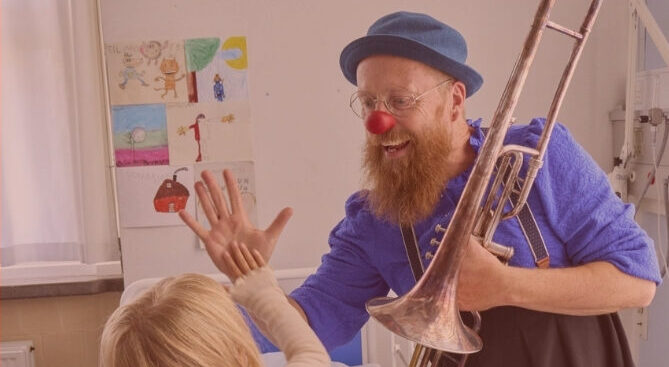
Hospital clowns use music, play and improvisation, among other things, to create a sense of security and presence for children and young people during their treatment. Photo: Danske Hospitalsklovne.
Danish Hospital Clowns has opened applications for a new intake of hospital clown apprentices, with the training starting in January 2027. See the practical details in the fact box at the bottom of the article.
The association is looking for people with various creative and artistic expressions who would like to use their professional skills in encounters with, among others, hospitalized children, young people, their families and people with dementia.
It is not a requirement that applicants have a formal artistic education.
The training lasts a year and a half and is undertaken on a part-time basis. The teaching includes, among other things, clown technique, improvisation, dance, voice use and puppet manipulation, as well as an introduction to hospital hygiene and work in somatic and psychiatric departments.
Danish Hospital Clowns expect to enrol between eight and twelve apprentices. There are no tuition fees for the training, which is funded by the association, and it is possible to have other work on the side.
83 trained hospital clowns nationwide
In 2025, Danske Hospitalsklovne had 83 professionally trained hospital clowns, after 14 new clowns completed their training during the year.
Together, the hospital clowns completed 8,500 clown shifts and had over 50,000 encounters with children, young people and their families. Furthermore, during 89 per cent of the shifts, the hospital clowns took part in various treatment procedures.
An example is a project at Aarhus University Hospital, where hospital clowns collaborate with radiographers and anaesthetists to create a secure environment for MRI scans. According to the Danish Hospital Clowns' annual report, 94 per cent of the participating children completed the scan without the use of general anaesthesia.
Employment on standard terms
Upon completion of their training, graduates are generally offered employment with Danish Hospital Clowns. The vast majority of permanent staff work around three clown shifts a week, but the number varies, and the work can be combined with other artistic projects.
The Danish Musicians' Union has entered into a special collective agreement with the association Danish Hospital Clowns. The agreement ensures proper pay and working conditions, pension, and guidelines for, among other things, working hours and shifts for the hospital clowns employed by Danish Hospital Clowns.
If you’d like to find out more about what working as a hospital clown is like in practice, you can read *Artisten*’s 2024 interview with hospital clown Martin Ingleby: »Magic happens«. Here, he talks about improvisation, presence and the special bond that can arise between the hospital clown and the child.
View all requirements and dates, and submit your application to Danske Hospitalsklovne.
- Information evening 25 August, 7–9 pm at Studenterhuset Aalborg. Attendance is free.
- Closing date: 11 September 2026.
- Start of training: 8 January 2027.
- Duration: A year and a half part-time.
- Number of seats: Expected capacity: 8–12 seats.
- Price: No user charge.
- First audition: 19th–22nd October in Aarhus.
- Second entrance examination: 16th–18th November in Nykøbing Sjælland.