Circus performers' recognition and opportunities are growing
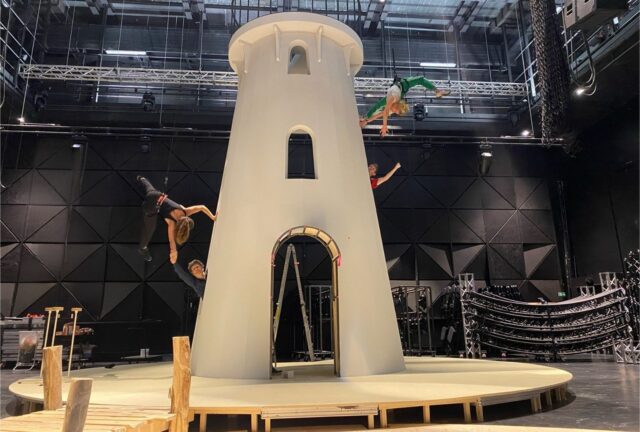
Søren Hauch-Fausbøll, Sunniva Byvard, Michael Slebsager, Anna Emilie Pedersen and Sofie Tone Nielsen starred in the production of Gabriel's Wings at Vendsyssel Theatre.
"Right now, the entire performing arts industry is talking about the upcoming performing arts reform, and there is broad agreement on a financial boost for the independent field. That's why it's especially important to focus on and celebrate those who are already doing fantastic work to ensure fair treatment of the most precarious parts of the performing arts industry."
This was the call from the wide range of industry associations behind the Fair Practice Performing Arts Award. In this article, we focus on some of the scenes that prioritise contemporary circus and highlight trends and artists that are helping to manifest and develop the genre.
One of them is Norwegian contortionist and trapeze artist Elise Bjerkelund Reine, who has just joined the Career Programme The Young Artistic Elite (DUKE) on the grounds that she is "a leading figure in experimental circus for adults."
The programme aims to help young talents develop their artistic work and advance their careers nationally and internationally.
"I see it as a great recognition of my artistic work and an incredible opportunity to develop as a performing artist in the independent field," she says, elaborating that she is thinking both about her development on stage and about getting more structure in all the work that independent producers also do alongside their artistic work. She is particularly happy to be part of the programme because it means that those who select the participants see artists working with experimental circus formats aimed at adults as part of the performing arts landscape in Denmark.
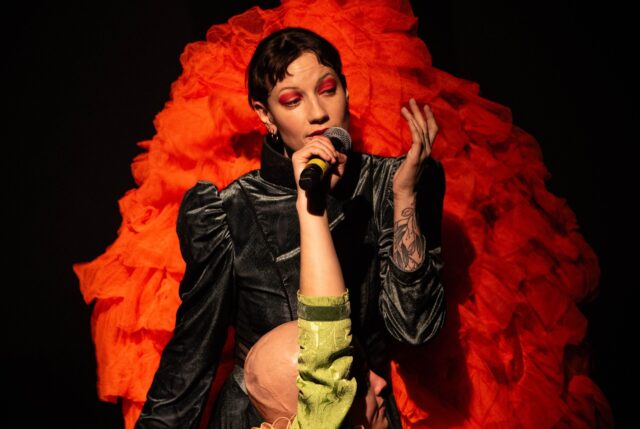
Elise Bjerkelund Reine has been accepted into DUKE - a career programme for circus artists. Photo by Andreas Bergmann Steen
"A lot of people want to see things they already know, the traditional circus. I'm interested in the experimental and see myself as a performing artist with circus as a language, but when you say circus, you're perceived as someone with a tent. Like many others, I want to show that circus can do more than just entertain children at Bakken," she explains, who, in addition to her own art, will again be curating Feral Festival, which presents circus for adults.
"It's been a wonderful year for me because I've joined DUKE, where I'll be working with my mentor, Kitt Johnson, and other Nordic producers and consultants. I've also received a working grant from the Danish Arts Foundation, which has given me freedom and a better opportunity to establish myself, but at the same time I've only been rejected by PUS (Project Support Committee for Performing Arts) to create and perform shows in Denmark," she explains, hoping that the recognition through DUKE will help her projects be considered by PUS in the future.
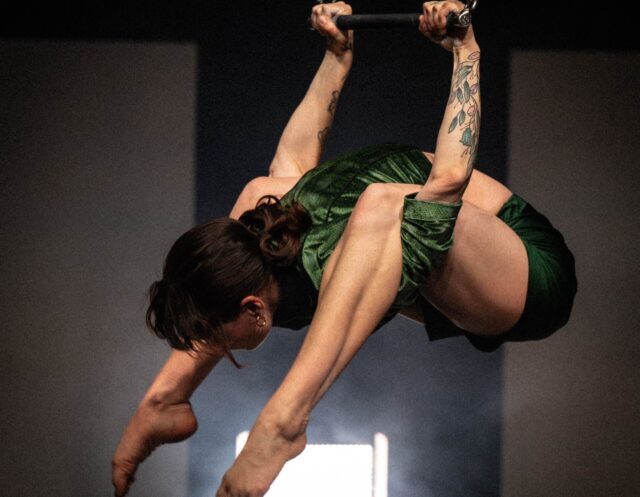
Elise Bjerkelund Reine is a trapeze artist and does experimental circus for adults. Photo by Andreas Bergmann Steen
Circus disciplines make theatre sensual
The potential of the cross-aesthetic is this year's recipient of the The Fair Practice award, Vendsyssel Theatre, a good example of.
This applies to the fusion of film and traditional circus in A seat in the ring, that played earlier in the season. The mix of theatre, music, clowning and contemporary circus in the family shows The Snow Queen (2023) and the current Gabriel's Finger, both co-directed by artist and circus choreographer Sunniva Byvard.
Vendsyssel Theatre's director Rolf Heim took over in 2023 after 20 years at Bådteatret, where he was responsible for puppet theatre for adults. In Vendsyssel, he was given a clear task of lifting the theatre's finances, and contemporary circus has played a key role in making the theatre relevant to its audience again.
"Both contemporary circus and puppet theatre, which I've worked with before, add a new layer to the performances. It's more poetic and not so intellectual. Both genres have a lot to offer in terms of emotions and the magical and the sensual. It's not about technique but about building circus into the theatrical context," he explains and continues:
"The audience here didn't realise there was so much in the circus genres. Perhaps especially in relation to family performances, there is something special about real bodies flying through the air. That it's live and sensual with artists who can do something different with their bodies. Maybe it's also part of our time that we want to dream ourselves away with a wildness that goes beyond the everyday, just as there has been a fantasy wave in film," he reflects.
Associate Professor at the Department of Arts and Cultural Studies at the University of Copenhagen, Michael Eigtved, works with performance studies and describes the new contemporary circus as circus with a concept that spreads to all parts of the performance. The artists use their physical skills and circus disciplines in context and create a theatrical framework for the performances, he explains:
"A show doesn't become a contemporary circus by having a single performer, but of course performers should be involved in all kinds of shows. Artists are like ballet dancers or opera singers. Disciplines that all require extreme technique and body control."
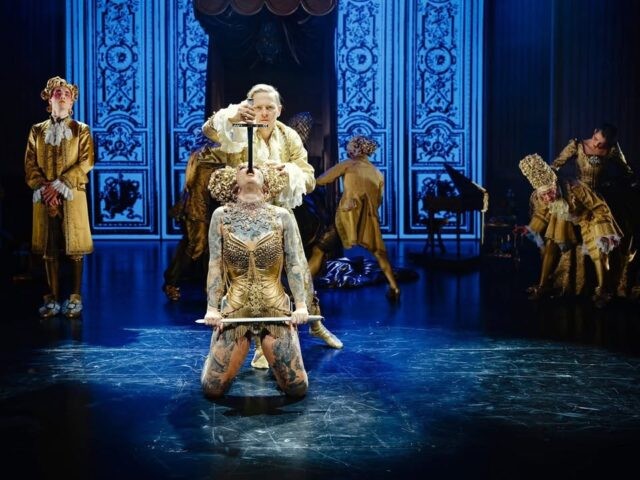
Artist and sword swallower Cecilia Gosilla centre stage with actor Thure Lindhart at Aarhus Theatre. Christian Lollike's version of Holberg's comedy Jeppe of the Hill won a Reumert in 2025. Photo: Rumle Skafte
Things are moving
One of the important stages for contemporary circus, namely DYNAMO Workspace in Odense was honoured with the Fair Practice award last year, and this recognition helps to emphasise the positive development in the field, says DYNAMO's manager Gry Lambertsen:
"It's a recognition of us as an institution to receive an award. It means the world, because for many years there has been a feeling that you have to put a lot of effort into being recognised and professionalising yourself and the industry when you work with contemporary circus," she says, who feels that things are changing on several levels:
"Now it's about producing great shows so that the artists have the opportunity to stay in the industry and become role models for the newcomers. Awards can shed light on this, and a lot of what we've been wishing for is actually happening now," she says, pointing to the bachelor programme that starts this summer.
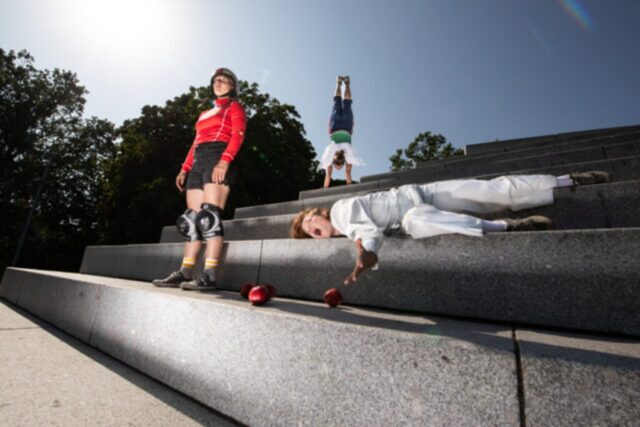
The contemporary circus performance Faldet by the company Cikaros was among the nominees for a Reumert earlier this year.
Open to the cross-aesthetic
The Vendsyssel Theatre's repertoire is one of several examples of how circus artists can be included on equal terms with other performing artists. Even on stages far outside the capital, because the cross-aesthetic and genre-mixing performances appeal to audiences.
In January 2027, director Rolf Heim and Vendsyssel Theatre are going all the way with a major Nordic theatrical contemporary circus production in collaboration with, among others, the Swedish Riksteatern and with French Camille Boitel as one of the directors.
Gry Lambertsen takes a positive view of the new cross-aesthetic paths, where the distinction between genres is not so rigid.
"It's perhaps just as important as education, for example, that we soften it and see the different genres as performing arts that work with the body in different ways. I think it's exciting that it's not so statically divided into genres anymore," she says.
Anchoring requires education and a strong food chain
Recognition will probably also improve when the bachelor's programme at the new Copenhagen Contemporary Circus College is established from next school year. The experimental programme AMoC (Academy of Contemporary Circus) ran from 2014-2016, but was not extended despite positive evaluations, which has made it more difficult for artists to establish themselves in Denmark.
Christina Koch, professor of circus and head of the master's programme in contemporary circus at Stockholm University of the Arts, points out that artists stay in the countries where they train, and therefore calls for more of what the industry has already done in Denmark, which now seems to be starting to pay off.
For her, it's about targeted funding for education, training, talent development and an infrastructure for production and touring, combined with a continuous branding dialogue with audiences, funders, critics and government. "Artists themselves are the best ambassadors when they have the opportunity to showcase their work, but they need to be supported with education, spaces, programmes and funding to be able to reach a wider audience," she states.
Head of CirkusmuseetMikkel Knudsen, broadens the educational perspective when he points out that circus is a regular part of the school timetable in several other countries.
"Circus is a very inclusive art form where everyone can have a role, and the artists, who are really good at dealing with a chaotic environment, could go more into education and spread the genre from there. You have to be able to put your ego aside and find the affirmation in the children succeeding," he suggests as another way to create a broader anchoring of the genre by supporting its food chain from primary school to higher education, as has been done in Sweden for decades.
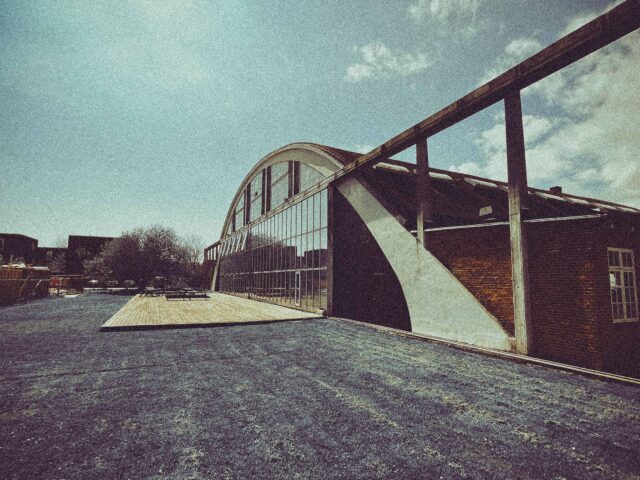
The new circus programme will be based in Copenhagen and will open for applications in April 2026. Photo: cccc.dk
The concrete and transformative potential of art
The performing arts reform is just around the corner, so there is a certain momentum to utilise the many potentials in the independent field in general and for the contemporary circus industry specifically. This is not only about better funding, but also about continued visibility of how contemporary circus contributes to society and the performing arts field through the development of aesthetic expression, audience engagement and sustainable and fair (co-)working conditions.
It's about jobs and tax money, but according to Christina Koch, it's also about circus being an accessible art form that, through its strong physical and visual expression, can contribute to society's dialogue about what it means to live in our time.
"Try to imagine a society without the humanising influence of art. It would be a society without much of the pleasures of life, but also without essential educational and social aspects. Art has the unique ability to challenge perspectives and catalyse change. It is a force that shapes, influences and reflects society, and its soft power should not be underestimated," she states about circus' ability to speak into the present.
FACTS
The industry organisations Independent Performing Artists, Danish Stage Directors, Danish Scenographers, Danish Scenographers, Danish Artists' Council, Danish Actors' Association and Danish Artist Association jointly award the Fair Practice Performing Arts Award.
Copenhagen Contemporary Circus College will start the first bachelor programme after the summer holidays and open for applications in April 2026. You can visit the school website here.
Series of articles about artists specialising in the circus genres
During 2025, the Danish Artist Association will be spotlighting artists in the circus genres. In a series of articles, you can follow the artistic expressions of artists such as clownsEntertainers, magicians, acrobats, aerial artists or jugglers, bring to the Danish stages.
Text: Freelance journalist Anne Liisberg