When the education chain breaks, talent falls away
From parkour to specialised acrobatics, circus is popular with children and young people
Many children and young people are active in circus arts in organisations and clubs across the country. Over 150 associations, clubs, studios and children's circuses offer both training and instruction in specialised circus performance. Disciplines in related performance areas, such as parkour, pole dancing or aerial gymnastics, also get young people interested in pursuing circus professionally.
The figures come from the Danish Artist Association's survey, which shows that young talents across the country continue to improve their circus skills - but mainly in private programmes or abroad. The same survey also shows where the chain breaks, namely around the high school years and in higher education. And this is a loss for Danish society, says the artists' spokesperson, Sara Indrio:
"Parents accompany them to training, young people spend many, many hours improving their skills. And instead of us as a society rewarding them with an opportunity, in line with the offers for music, drama and visual arts in high schools, to make room in the timetable to continue while taking a basic education, they are either forced out of the school system or out of the circus dream. And ultimately - for the few persistent ones who continue in spite of this - all the way out of Denmark to Sweden, for example," she says.
Danish Artist Association mapping is just the first step
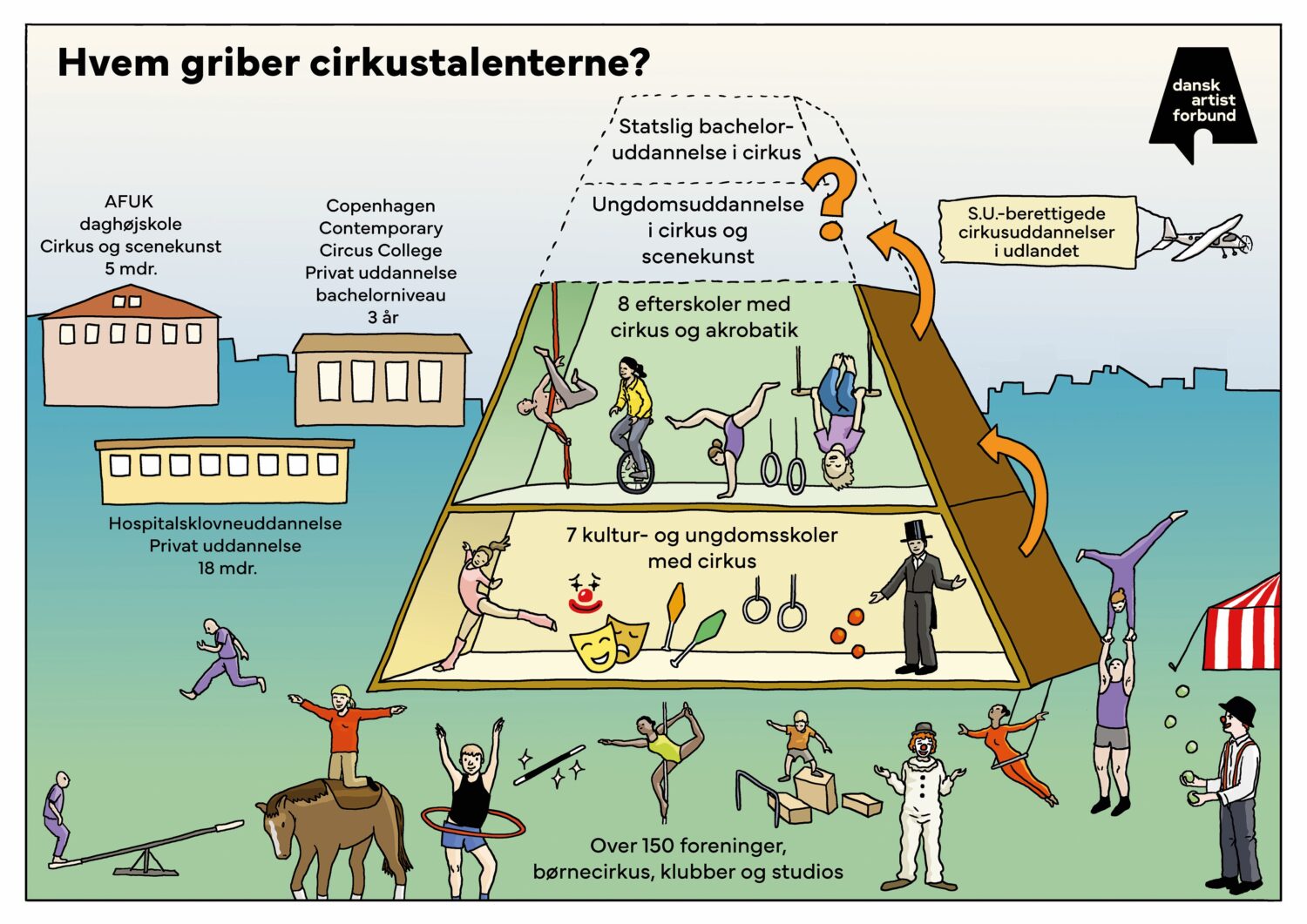
The Danish Artist Association has mapped all the places where children, young people and young adults can learn circus skills. It shows a serious kink in the education chain, as shown in the drawing above. It requires political involvement to move circus from pure popular entertainment on commercial terms to being recognised as a form of art and expression, as it is in other European countries. One of the most important things is numbers and knowledge about the entire field.
Dansk Artist Forbund works to strengthen employment and working conditions for Danish artists and companies. The association's efforts focus on strengthening the circus food chain and gathering knowledge about employment, professionalism, audience and audience development that can benefit the whole.
"We need help in the form of support from the entire performing arts community, the performing arts in general and the committed, talented politicians who, like us, can see the potential here," says Sara Indrio and adds:
"A national stage, a knowledge centre, training opportunities for talent and synergy between classical and contemporary circus - I can tick off the whole wish list."
Circus talent goes to private schools or programmes abroad
Even after the cultural and continuation schools, circus genres disappear completely from the accredited educational programmes. There are no youth or higher education programmes covering the art form in Denmark.
Danish circus and physical performance talent can only progress through private or semi-private schools and programmes, including Copenhagen Contemporary Circus College, AFUK, Comedia Del Arte, Hospitalsklovneuddannelsen, or by travelling abroad and applying to circus colleges or vocational schools.
"We're experiencing an increasing demand at a high level that is simply difficult to fulfil," says Sara Indrio.
Anchoring circus will develop audiences and potentials
Circus is a success, but the profession suffers from a lack of anchoring and a coherent political effort so that more Danish talent will choose the profession and secure the future of the circus industry, says the artists' spokesperson Sara Indrio.
"A well-functioning and unbroken education chain not only strengthens the individual artist, it also increases revenue and audience influx to the performing arts. It's about stimulating the industry's food chains, development across genres and audiences, export opportunities, training opportunities, production spaces and commercial potential. Already today, there are about as many audiences for circus as there are for dance - and new formats at the intersection of theatre and circus are a breath of fresh air that the Danish stages want to embrace."
Historically, it has not been possible to ensure a permanent higher education opportunity at the highest level, in the same way as the other performing arts forms. In this way, Danish performing arts lose the narrative power that lies in the special expression that clowns, magicians and artists have developed over the centuries, says Sara Indrio.
She sees it as an important step forward that Copenhagen Contemporary Circus College now opens a private circus programme at bachelor level, but states that the programme should be state-run in line with other performing arts programmes.
"To retain circus talent and audiences, Denmark must have educational programmes at SGK level, in HF and upper secondary schools, and a higher performing arts education in circus. A basic prerequisite for the level of Danish artists is that the artists can match the demand and fulfil tasks on many levels, and this requires a strengthened food chain.
RIGHT NOW: Deadlines for acute circus programmes: Bachelor's level and day school
Danish Artist Association mapping is just the first step
Dansk Artist Forbund has mapped all the places where children, young people and young adults can learn circus skills. See which training programmes the mapping covers.
Facts about artists in the circus genres
10 % of Danish performing artists work in ciThe mug genres
The Danish Artist Association estimates that 350 - 400 artists work in circus genres such as magic, clowning and acrobatics (2024 figures)
This corresponds to just over 10% of all performing artists in Denmark (Statistics Denmark 2024).
Broad labour market in performing arts, events and education.
Figures from previous bachelor programmes (experimental programme at the Academy of Modern Circus) and DAF's surveys show low unemployment. High-level artists are in demand, especially at the largest Danish theatre venues, including the Royal Danish Theatre, Randers Theatre, Vendsyssel Theatre and Østre Gasværk. All trained hospital clowns are in work.
Over 150,000 tickets sold for contemporary circus and performance in 2022
In 2022, over 150,000 spectators bought tickets to contemporary circus and performance, according to Statistics Denmark. In comparison, the audience numbers for classical ballet and modern dance combined were just over 80,000 higher.
