Basic income or not?
A steady income can give artists, musicians and other performing artists more work peace and financial security to develop their art. But is basic income the right path for Denmark? During a debate and workshop in Aarhus, Sara Indrio, spokesperson for the Danish Artists’ Union, discussed other countries’ solutions. The workshop participants highlighted France and Belgium as possible models, because their systems specifically take into account short-term employment and periods between assignments.
By Julie Westh Nielsen
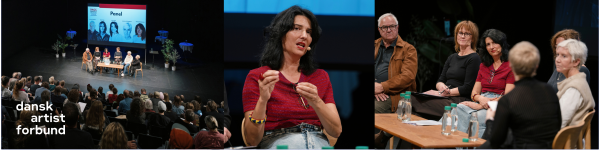
Denmark needs an employment and support system that takes into account the special labour market conditions of artists. This was the conclusion, according to Sara Indrio, the head of the Danish Artists’ Association, among a wide range of stakeholders at the workshop she held in Aarhus on October 9th.
The day before, Sara Indrio participated in a panel discussion at Bora Bora in Aarhus about what Denmark can learn from other countries’ solutions to artists’ precarious economic conditions.
Work before the salary
The idea behind basic income for artists is to provide a fixed public amount over a period of time so that the economy becomes more predictable. This can create space to practice, develop new material, or prepare a performance before the work generates an income.
In Ireland, basic income for artists has been made available a permanent arrangement. The new round includes 2,000 selected professional artists who receive 325 euros a week before taxes for three years. That corresponds to approximately 10,500 kroner a month.
Admission requires documentation of professional artistic work and a base in Ireland. Among the qualified applicants The recipients will be selected by drawing lots. Even if you meet the requirements, you are therefore not guaranteed support.
The recipients can continue to earn money in addition. The support is linked to their ongoing work with the art rather than to a specific production or performance. They must document along the way that they continue to meet the requirements and contribute information to the evaluation of the scheme.
For the individual, the support is time-limited. A recipient in the new three-year round must skip the subsequent round, Before they can apply again. The scheme therefore provides some years of security for a portion of their income, while other artists remain outside the system.
More paths to security and recognition
The Irish experiment The results showed that the recipients had more time for the artistic work in particular. After two years, they spent an average of about 11 hours more per week on their art than a comparable group that did not receive the support. At the same time, they worked less outside the art field and experienced better well-being.
Other countries have chosen other solutions. In France and Belgium Artists may earn the right to special benefits between assignments. Here, the support is part of the unemployment insurance and depends, among other things, on previous work.
The French system It includes performing artists and technicians in the fields of performing arts, film and television, among others, when they meet the admission requirements. It illustrates an important point in the debate: One can have a professional artistic career even though the employment is short-term and the income is irregular.
For a musician or dancer with many short engagements, security between assignments can be particularly important. A circus artist or comedian developing a new performance may have greater need for consistent working hours. The same person may have both needs throughout their working life.
A system that suits the artists’ working lives
At the workshop on October 9, the participants pointed to the systems in France and Belgium as the most relevant sources of inspiration for Denmark. Here, the financial security is adapted to a work life with short employment periods and periods between tasks. The starting point of the workshop was that the changing work conditions of artists are a condition that the employment and support system must be able to accommodate.
A basic income based on the Irish model could be more complicated to implement in Denmark, according to the participants, because it would have to be aligned with other transfer incomes. This would require clarification of how the benefits interact and what the individual artist would gain overall from the scheme.
A Danish model is still under discussion
Denmark already supports artistic development through, among other things Work grants from the State Art Fund. Here, professional committees distribute the support. A Danish discussion therefore also concerns who should have access, and whether the support should be granted based on an expert assessment, financial need, or other criteria.
The Danish Artists’ Union has Previously sought more dialogue and knowledge about how the Irish experiences can be used here at home. There is still no adopted Danish scheme or starting date. Who, if anyone, can receive a basic income, how much and for how long, requires political decisions and funding.
A Danish model also needs to fit into the context of daily allowances, maternity leave, illness and pension. In Ireland, for example, the basic income can be affect other services, This depends on the recipient's income. Therefore, the amount in the account is only one part of the calculation.