New circus training program aims to strengthen the entire Danish circus community
12 students have started the three-year degree program in contemporary circus at CCCC. Rector Anne Mette Nørskov sees it as the foundation for new companies, more collaborations, and professional development for both future and experienced artists.
By Julie Westh Nielsen
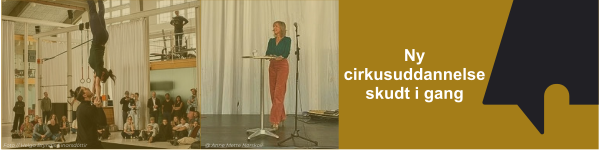
At Holmen in Copenhagen, 12 students are specializing in circus arts. They form the first class at Copenhagen Contemporary Circus College (CCCC), which opened a three-year program in contemporary circus in September, which the school describes as equivalent to a bachelor's degree.
Thus, Denmark has once again gained a long-term, high-level circus training program, after the pilot program at AMoC ended in 2018. For Rector Anne Mette Nørskov, it is about giving the circus art better opportunities to develop.
A meeting place for new and experienced artists
Artists and performing artists who already work professionally also benefit from the new educational environment. CCCC offers both short and longer-term courses where experienced practitioners can learn new skills and develop their existing practices.
One of the offers is an 11-week intensive course focusing on acrobatics, handstands, and movement, aimed at both aspiring and professional circus performers.
The school will also open its doors to meetings between students and professionals, invite the public to view performances, and welcome circus artists and troupes for inspiration and professional exchange.
CCCC is housed in a former waterplane hangar near the Danish Theatre School and the Rhythmic Music Conservatory. The school hopes for strong collaboration with the other artistic programs at Holmen, so that the students can build networks and create projects across the arts early on.
More talents based in Denmark
According to Anne Mette Nørskov, Danish circus training can also influence where artists choose to settle down. She points out that young circus talents have had to seek training abroad for many years in order to obtain higher-level education. Here they build networks that can have an impact on where they later establish their working lives.
Therefore, she sees potential in both providing Danish artists with an educational opportunity here at home and attracting international talent.
In the long term, she expects the training to lead to new companies and performances based in Denmark and create opportunities for, among others, circus educators, instructors, choreographers, producers and technicians.
Circus requires time for immersion
The fact that the training lasts three years is crucial.
Students need space to experiment, fail, collaborate, and meet an audience. This should equip them for a professional working life, both as independent circus artists and as part of larger artistic communities.
Samtidscirkus ranges in her description from large productions to small poetic narratives and abstract works. The art form stands on the shoulders of traditional circus and simultaneously explores other stages, narrative forms and ways of meeting the audience. According to her, this development requires an education that is created on the circus’s own premises.
A lasting place among the art education programs
CCCC is a private school that works for public recognition and support. According to the school, the education is not yet eligible for student financial aid. Anne Mette Nørskov’s ambition, however, goes beyond the current offer:
Read more: CCCC's training and intensive course.
Also read: New high-level circus training programme starts in 2026.